Build series · Game mechanics
Game mechanics.
RepGarden’s game has its rules now: an old woman who falls ill every Monday, a farm that grows vegetables from the sets you log, and a week you can share. Here is how they fit together, and the one thing I have left undecided on purpose.
By Ahmed Gadir3 min read
Fun, but quiet enough for the gym
After a few days of planning, I've worked out RepGarden's game mechanics: the goals, the rewards and the consequences inside the app. RepGarden is the personal training app I'm building for Benji, a personal trainer, and his clients. Nothing of it is built yet, and the series page has every entry so far.
Creative work is usually the part I enjoy most, and this still took a while to feel right, because the brief pulls two ways. The game has to be fun and vegetable-themed: the theme is a carrot getting stronger at the gym. And it gets used at the gym, between sets, so nothing on screen can be busy or distracting.
Three styles, one chosen
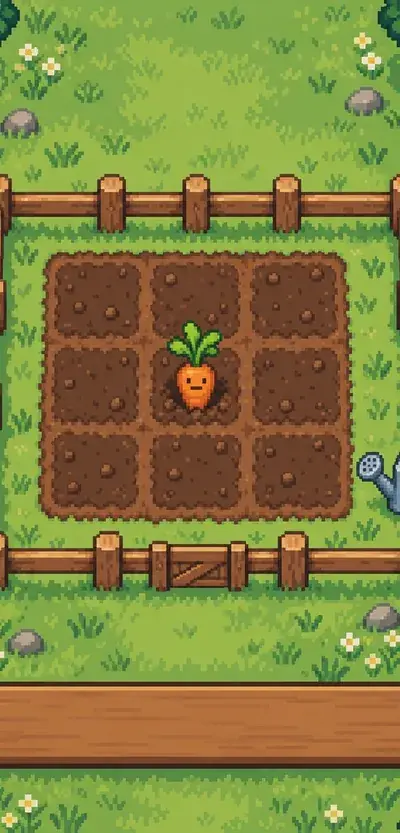
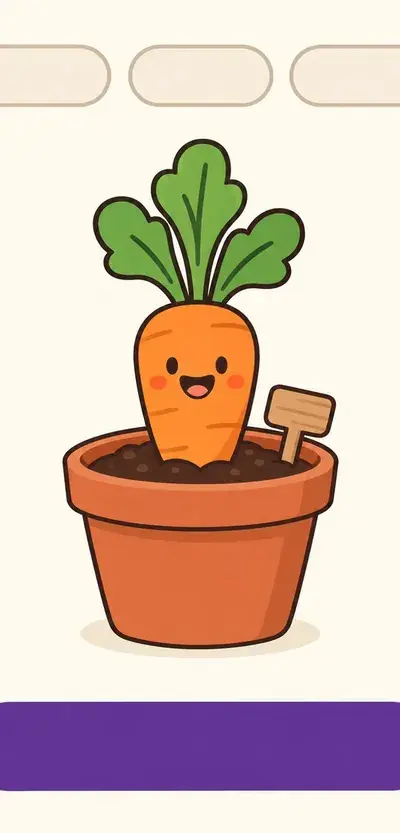
I started with concept art in three styles. Pixel art was too busy. 3D animated models could come later, but not for the MVP, the first version that real clients will use. In the end I landed on a simple, flat cartoon style: clean and minimal.

Mrs Patata and the farm
The game is built around a little old woman called Mrs Patata. At the start of every week she comes down with the flu, and her husband, Mr Patata, relies on the player to help cure her.


The players are Benji's clients. In the game they own a little farm, and they grow its vegetables by working out.
One week, start to finish
Every week, when Benji or another personal trainer sets a client's workouts, a box of seeds and roots turns up on the farm. On each workout day the client plants them, and every set they log makes them grow.
- Train well, and they grow into strong vegetables that can heal Mrs Patata.
- Hit a personal best, and they get super jacked and turn gold.
- Have a bad session, and they come out feeble, which is no use to a little old lady with the flu.



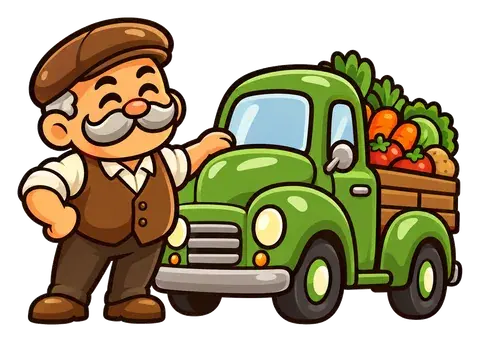
At the end of the week, Mr Patata turns up in his truck to collect the harvest. He makes a nice stew to cure his wife, sells the rest at a local market and gives the farm the profits. Then it is Monday again, and Mrs Patata is ill again.
Game designers call a cycle like this the core loop: the thing a player does over and over, and the reason they come back. RepGarden's loop is a week long, and what drives it is the sets a client logs.
A week you can share
Every week's results also become a grid of coloured squares that a client can share with friends and family.
Grids like this have already made one game spread. In early 2022 a daily word game took over social media on grids of coloured squares that players posted after each puzzle, and more than 300,000 people played a single day's puzzle in the first days of January.[1] Think about what that means for an app: distribution built into the app itself. Every share is a free ad.
The money, left open on purpose
I haven't decided what the farm will do with its profits yet, and that's on purpose. You can't one-shot an app in the design phase, meaning design the whole thing in one go before anything is built. Trust me, I've tried.
I spent two years designing my last app, ArabyBuddy, a language-learning app, perfecting the mechanics in my head. It was a beautiful castle in the sky, with pearly gates and trimmed hedges. When I built the first prototype, which was everything I had planned, I realised how much of it was wrong or missing.

So I won't make that mistake here.
Where things stand
Decided: the flat cartoon style, Mrs and Mr Patata, the farm and its weekly loop, and the shareable grid. I've had a call with Benji, and he likes the plan. Open: what the profits are for. Nothing of the game is built yet. Next come rough mock-ups and the user journeys, the paths a client takes through the app, from opening it to logging a set. The design notes are in the RepGarden repository on GitHub.
Sources
Gita Jackson — Why Is Everyone Tweeting Their ‘Wordle’ Scores? Vice, 5 January 2022. On the grids of coloured squares players shared after each puzzle, and, citing the New York Times, the more than 300,000 players who took part in one day’s puzzle.