- Launch
- Pricing
Move the paywall earlier
By Ahmed Gadir
Published
Summary
Three free units felt generous and converted badly. Moving ArabyBuddy’s paywall to after the first unit brought about five times as many trial starts per new account in the month after, and six and a half times the number of trials. People buy while they still want the thing, so put the paywall at the first moment they want more, not after they have had their fill.
I gave away less, and more people paid.
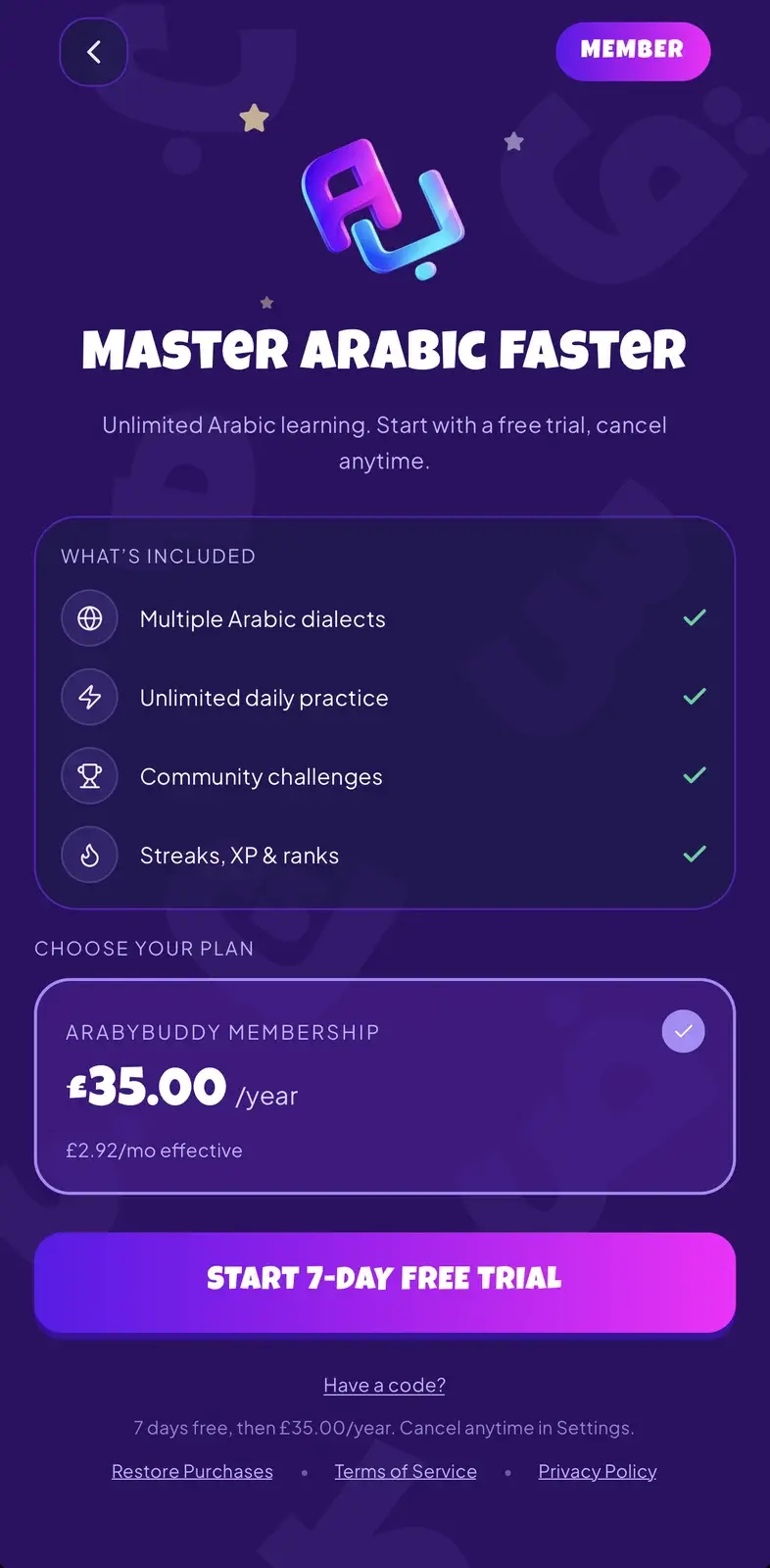
ArabyBuddy, my Arabic-learning app, used to let a new user finish three units before it asked them to start a trial. On 3 October I moved that paywall to after the first unit. In the month that followed, six and a half times as many trials started as in the month before, and about five times as many new accounts went on to start one. [1] One setting changed, and no app update went out for it.
Why I gave away three units
The reasoning felt sound. Give people as much of the app as possible before asking for money, so they know what they are paying for. I had raised the free allowance in steps over the summer, from one unit to two and then to three, on that logic.
A unit is one step on the app’s trail: a flashcard deck, or a lesson built from games. Three of them is a good sitting. Then the paywall.

Sell at the highest point of desperation
Alex Hormozi’s line is that you sell to people at their highest point of desperation, because that is when they are most motivated. Someone who wants a thing right now will pay for it right now. Give them their fill first and the same price looks different, because the want has gone.
Behavioural economists have studied this for decades. George Loewenstein showed that a need felt in the moment crowds out almost every other goal, and that a need you will only feel later has little reality to you now. [2] It shows up in markets, not only in the lab:
- After a snowstorm of about ten inches, the share of cars sold with four-wheel drive rises for the next two or three weeks, then fades back. The fix sells while the problem is outside the window. [3]
- The New York Times cut its free articles from twenty a month to ten in 2012 and told investors that paid digital subscriptions had benefited from moving the gate. It cut to five in 2017 and to four in 2018, and never went back up. [4]
- Across more than 115,000 subscription apps, about half of all purchases happen on the day of install, and fewer than one trial in twenty starts after the third day. Language apps sit in the education category, the slowest to convert on the first day, and even there most trials start on day one. [5]
Three units took my users past that window on purpose.
What I changed, and what happened
The allowance is a setting the app reads when it starts, so the change was live the moment I saved it, with nothing to send through the app stores. Trial starts in the month after were six and a half times the month before, and the share of new accounts that started a trial went up about five times. [1] Five times a small number is still a small number, I know.
The numbers behind this are small, as a young app’s are, and two app updates went out in the same window, so treat it as one app’s result rather than a law. Two free units had converted nearly as well as one; three was the step that broke it. The point is not that free is bad. It is that the ask has to arrive while the person still wants more.
If you are placing a paywall
- Put it at the first moment the user wants more: the first unit finished, the first result seen, the first thing they reach for next. Not after they have had their fill.
- Make the allowance a setting you can change without a release, and then change it. A number in a config table taught me more in a month than the reasoning did in a summer.
- Measure trials per new account, not sign-ups. The allowance does not change who signs up; it changes what they do next.
- Give the window days, not weeks. Most of the people who will ever start a trial do it on the day they install.
Sources
ArabyBuddy’s own figures. Trial starts and new accounts from the app’s subscription and account records, comparing the 30 days before 3 October 2026 with the 30 days after. A trial start counts a store trial or purchase, with promotional grants and test accounts excluded; a new account counts every account created, guests included.
Loewenstein — visceral influences on behaviour, 1996. George Loewenstein, “Out of control: Visceral influences on behavior”, Organizational Behavior and Human Decision Processes 65(3), 272–292. The paper.
Snowstorms and four-wheel drives, 2015. Busse, Pope, Pope and Silva-Risso, “The psychological effect of weather on car purchases”, Quarterly Journal of Economics 130(1), 371–414, from more than 40 million US vehicle transactions. The figures are from the NBER working paper: a storm of about ten inches raises the four-wheel-drive share by about two percentage points for two to three weeks. The published paper.
The New York Times meter. The company’s second-quarter 2012 results: “The growth in paid digital subscriptions benefited from our decision to move the gate on NYTimes.com from 20 to 10 free articles a month, and from a host of marketing and product initiatives.” The results, filed with the SEC. The cut to five: Reuters, December 2017. The cut to four: Digiday, November 2018.
RevenueCat — State of Subscription Apps 2026. More than 115,000 apps. Day-zero conversion is 50.6% overall and 28.5% for education apps; 78.5% of education trials start on day zero; after day three, trial starts fall below 5% in every category. The report.